

Rakibul Hasan
Chief Editor of - Autos DonationRakibul Hasan, the CEO and founder of Autosdonation, is an automotive specialist with over a decade of industry experience. With a distinct mastery in car...Read more
Are you thinking of donating your car to a charitable organization? Not only can it be a generous act, but it can also have potential tax benefits. But what if you don’t itemize your deductions or don’t have enough deductions to make it worthwhile? Is a car donation tax deductible even if you don’t? Let’s dive into the details and find out.
When it comes to car donations, there are a few things to consider. If you don’t itemize your deductions on your tax return, you won’t be able to claim a tax deduction for your car donation. However, there are still ways to potentially benefit from your donation, even without the tax deduction. Let’s explore the options and see how you can make the most of your charitable contribution.
Yes, a car donation is tax deductible even if you don’t itemize your deductions. The IRS allows taxpayers to take a standard deduction or itemize their deductions, whichever results in a larger deduction. If you choose to take the standard deduction, you can still claim a deduction for your car donation up to $500. However, if your car is worth more than $500, you will need to itemize your deductions to claim the full deduction.
Is a Car Donation Tax Deductible Even if You Don’t?
Car donations are a popular way to donate to charity while also getting rid of an unwanted vehicle. Many people assume that donating a car automatically makes them eligible for a tax deduction. However, this is not always the case. In this article, we will explore whether car donations are tax deductible, even if you don’t itemize your deductions.
Understanding Tax Deductible Donations
When you donate a car to a qualified nonprofit organization, you may be eligible for a tax deduction. The amount of the deduction will depend on several factors, including the fair market value of the vehicle, the charity’s tax-exempt status, and your own tax situation.
If you itemize your deductions on your tax return, you can claim the fair market value of the car as a charitable contribution. However, if you do not itemize your deductions, you cannot claim the deduction.
How to Determine the Fair Market Value of Your Car
To determine the fair market value of your car, you can use a car valuation tool such as the Kelley Blue Book website. This will give you an estimate of what your car is worth based on its make, model, and condition.
It’s important to note that if the charity sells your donated car for less than $500, you can claim the fair market value of the car up to $500. If the charity sells your donated car for more than $500, you can claim the actual sale price of the car.
The Benefits of Donating a Car
Donating a car to charity can have several benefits. Firstly, it’s a great way to give back to your community and support a cause you care about. Secondly, it can help you get rid of an unwanted vehicle without having to go through the hassle of selling it. Lastly, if you do itemize your deductions, you can potentially save money on your taxes.
The Drawbacks of Donating a Car
While there are many benefits to donating a car, there are also some drawbacks to consider. For one, you may not be able to claim a tax deduction if you don’t itemize your deductions. Additionally, the process of donating a car can be time-consuming and require a lot of paperwork. Lastly, the charity may not be able to use your car for its intended purpose, which could result in it being sold for a lower price than you anticipated.
Donating vs. Selling Your Car
When deciding whether to donate or sell your car, there are several factors to consider. If you need to sell your car quickly, selling it may be the best option. However, if you have time to spare and want to support a charitable cause, donating your car may be a better choice.
Another factor to consider is the potential tax deduction. If you don’t itemize your deductions, you won’t be able to claim a tax deduction for donating your car. However, if you do itemize your deductions, you could potentially save money on your taxes by donating your car.
The Bottom Line
Donating a car to charity can be a great way to support a cause you care about while also potentially saving money on your taxes. However, it’s important to understand the tax implications of your donation and make sure you’re eligible for a deduction before making the donation.
If you’re unsure whether you’re eligible for a tax deduction for your car donation, it’s best to consult with a tax professional or speak directly with the charity you’re planning to donate to.
Contents
Frequently Asked Questions
Donating a car to charity can be a great way to get rid of a vehicle you no longer need while also supporting a good cause. One of the biggest benefits of donating a car is the potential tax deduction you can receive. However, there are some misconceptions about how car donations and tax deductions work. Here are some frequently asked questions about car donations and taxes.
1. Is a car donation tax deductible even if you don’t itemize your deductions?
Yes, it is possible to receive a tax deduction for a car donation even if you don’t itemize your deductions on your tax return. In 2021, the IRS introduced a temporary universal charitable deduction, which allows taxpayers who don’t itemize to deduct up to $300 in charitable donations, including car donations, on their tax return. This deduction is available to all taxpayers, regardless of whether they take the standard deduction or itemize their deductions.
However, if you donate a car worth more than $300 and want to claim a larger deduction, you will need to itemize your deductions on your tax return. This means you will need to keep track of all your deductible expenses throughout the year, including mortgage interest, property taxes, and charitable donations, and report them on your tax return.
2. How much can you deduct for a car donation?
The amount you can deduct for a car donation depends on the value of the car and how the charity uses the donation. If the charity sells the car, you can typically deduct the fair market value of the car at the time of the donation. If the charity uses the car for its own purposes or donates it to someone in need, you can typically deduct the car’s fair market value or the charity’s actual expenses related to the car, whichever is less.
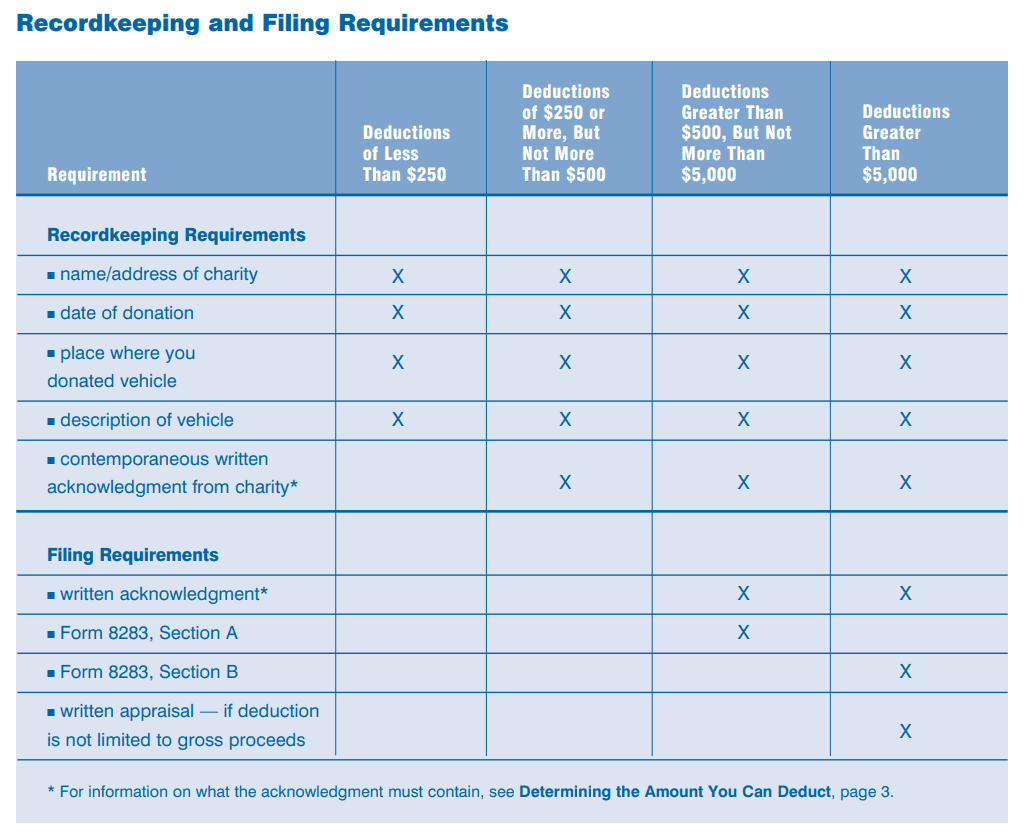
It’s important to note that the IRS has specific rules for valuing car donations, and you will need to provide documentation to support your deduction. If the car is worth more than $5,000, you will need to obtain an independent appraisal of the car’s value to support your deduction.
3. What documentation do you need to claim a car donation deduction?
To claim a tax deduction for a car donation, you will need to obtain a written acknowledgment from the charity that received the donation. The acknowledgment should include the charity’s name and address, the date of the donation, a description of the car, and a statement indicating whether the charity provided any goods or services in exchange for the donation. If the charity sold the car, the acknowledgment should also include the sale price of the car.
If the car is worth more than $500, you will need to file Form 8283 with your tax return, which requires additional documentation about the car’s value and how the charity used the donation. If the car is worth more than $5,000, you will need to obtain an independent appraisal of the car’s value and file Form 8283 with your tax return.
4. Can you donate a car that doesn’t run?
Yes, you can donate a car that doesn’t run to charity. However, the charity may not be able to use the car for its own purposes or donate it to someone in need if it is not in working condition. In this case, the charity will typically sell the car for scrap or salvage and use the proceeds to support its programs.
If you donate a car that doesn’t run, you will still be able to claim a tax deduction for the donation as long as you obtain a written acknowledgment from the charity and follow the IRS rules for valuing the donation.
5. What should you look for in a charity to donate your car to?
When donating a car to charity, it’s important to choose a reputable organization that will use the donation effectively. Look for a charity that is registered as a 501(c)(3) organization with the IRS, which means it is recognized as a tax-exempt nonprofit. You can also research the charity’s mission and programs to ensure they align with your values and goals.
You may also want to consider how the charity will use the donation. Some charities will use car donations to support their programs directly, while others will sell the car and use the proceeds to support their programs. Either way, make sure the charity is transparent about how it uses its donations and provides documentation to support your tax deduction.
In conclusion, donating your car to a charitable organization can provide you with a tax deduction. Even if you don’t have enough taxable income to benefit from the deduction this year, you can carry it forward to future years. This can be a helpful strategy for reducing your tax bill over time.
However, it’s important to do your research before donating your car. Not all organizations are eligible to receive tax-deductible donations, and the rules for deducting vehicle donations can be complex. Make sure you understand the rules and consult with a tax professional if necessary.
Overall, donating your car to a worthy cause can be a win-win situation. You can support a cause you believe in while also potentially reducing your tax bill. Just make sure you understand the rules and choose a reputable organization to receive your donation.

Rakibul Hasan, the CEO and founder of Autosdonation, is an automotive specialist with over a decade of industry experience. With a distinct mastery in car donations, sponsorships, and gifting, Rakibul combines his passion for automobiles and generosity to revolutionize the car donation landscape. He established Autosdonation to facilitate the car donation and gifting process, making it more accessible and enjoyable for all involved.
More Posts